Do women contribute to the glass ceiling and how?
What Happens In The World?
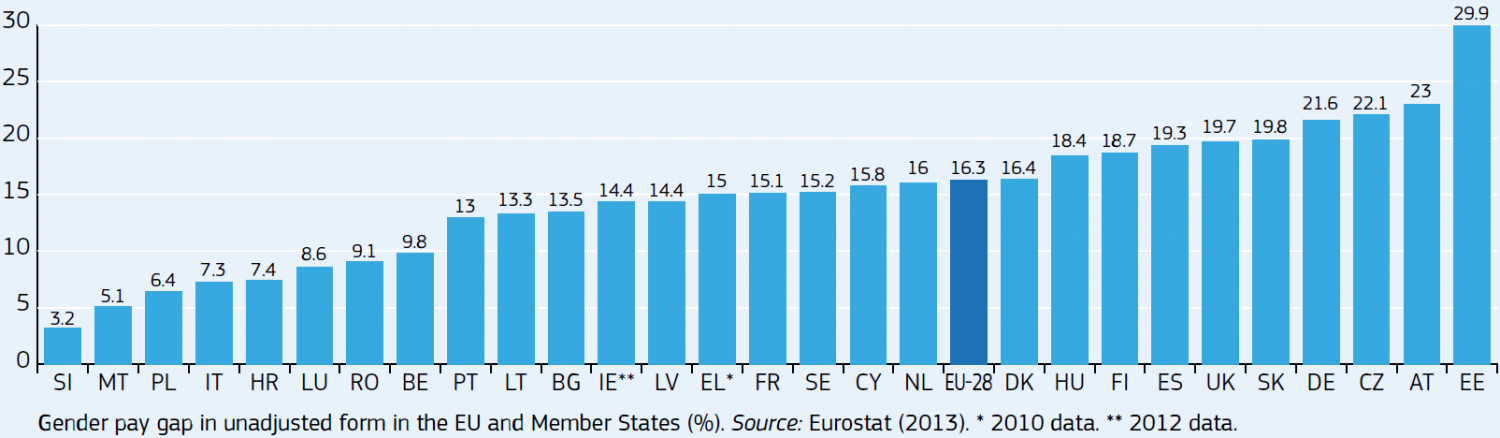
The first time I heard that women are paid less than men it was in Germany, in the early 90’s. As an Italian, I was astonished because in my perception Germany was much more modern and open-minded compared to sexist Italy. Twenty years later, it is a fact: women earn less than men. Even though calculating the pay gap is very complex, according to the European Commission in 2013 the average gender pay gap in the EU is 16.3%, ranging from a minimum of 3.2% in Slovenia to 23% in Austria. In Germany the pay gap is 21.6 compared to 7.3 in Italy. In the US, the average gender pay gap is 17.9%, according to the Organisation for Economic Co-operation and Development (OECD). So, not better than Europe. What about China? Researches show that Chinese women earn on average 35% less than men for similar work. Outrageous data.
How is it possible that in today’s progressive world there is still such
a discrimination towards hard-working and intelligent women?
In Saudi Arabia, the main reasons for the 20% gender pay gap are social and cultural. Men are meant to earn money outside the house, while women are expected to take care of the household. Even though the number of working women has increased due to some gender reforms introduced by the late King Abdullah Abdulaziz, so far only approximately 16% of Saudi Arabian women are working. Women’s work is not considered as valuable as men’s work, even in case of female engineers and lawyers. This results in lower salaries for women. Is this a matter of culture, misogyny, or cultural misogyny?
But let’s look at Europe. Why do women earn less than men? Even though the number of working women is much higher than in Saudi Arabia, in Italy for example you can still find many people who believe that women should actually stay at home, even though, of course, most men would deny it. The reason why so many women are working in Italy is mostly due to the fact that two salaries allow a higher standard of living, compared to having only the husband who earns money. For many Italian women that is the strongest motivation, and it has little to do with real career ambitions. Since they (are supposed to) care about their families, they often choose positions with lower responsibility, and hence the lower salary. This also applies to the average German working mothers. Part-time work opportunities are common in Germany, and many working-mothers choose that option. Of course there are exceptions.
When I was working at Daimler in Germany, my last superior was a woman. When she became pregnant with triplets she and her husband decided that he, a lawyer, would stay at home and take care of the children while she would continue her successful career, thus earning money for the family. Today she is the CEO of a Mercedes-Benz subsidiary. The gender pay gap was never an issue for her.
The Glass Ceiling
It looks like for some women the glass ceiling does not exist, while others find it impossible to break it. One question arises: do women earn less because they are paid less, or because they don’t ask for what they are worth? There is a big difference between the two. In the first case, women are paid less because someone else decides it. The employer/recruiter acts based on his own belief that women are less capable than men, or that women will be absent from work more frequently than men, and that would justify a lower pay. Or he believes that women are equal or better than men, but will accept to be paid less just to get the job. Here begins the fine line between the men’s responsibility for creating discrimination, and the women’s responsibility for allowing it to happen.
As a matter of fact, if a woman does not ask for what she is worth, or she doesn’t ask in the right way, earning less is often her own responsibility. And here is why.
I have seen at least two ways in which women unconsciously sabotage themselves when it comes to salary negotiations. For example, they pull together all their courage and ask for a higher salary, but deep inside they believe that their request will be rejected. When they eventually hear a “No”, they simply accept it and return to their desk grudgingly, thinking “I knew it”. Their own deep insecurity prevents them from considering the possibility of negotiating further or trying a different approach.
On the other side, very persistent ambitious women fail in their salary negotiations because they unconsciously create an environment for a fight. They believe they are considered outsiders in a men-dominated business world, and that they must act like men in order to be accepted in the inner circle. They enter the pay negotiation arena with the unconscious aim of challenging men and proving their value, exuding self-confidence and determination. Without being aware of it, they trigger a neurological reaction in their own and in the man’s brain, similar to what happens to two alpha-males confronting each other. That way, women don’t achieve their objective because the discussion does not remain rational, but moves to a primordial level where each party fights to demonstrate that they are more powerful than the other. Eventually, one wins, the other loses.
A Different Perspective
 If women want to break the glass ceiling and earn what they believe they are worth, they need to view things from a different perspective. They need to shift the focus from the eternal ‘men-women social battle’ to a purely commercial point of view. The primary purpose of organizations is to sell products and services that customers want to buy, thus generating profits for the shareholders. Organizations can be considered clients who are looking for a high quality professional, who can help them solve a specific problem, in order to generate those profits.
Let’s say that a company is facing the problem of opening a manufacturing plant in China, and is looking for a General Manager who has a good network of relationships in that market and knows how to manage the various local and global stakeholders. That would allow the company to speed up the process and begin operations within, let’s say, six months instead of one or two years. Considering what that would mean in terms of revenues, market share and competitive advantage, the salary paid to the General Manager becomes a minor issue. If the company trusts that the person is right for that position, no matter whether it’s a man or woman, they will do anything to hire and retain that talent. At this point, the salary negotiation will simply have the purpose of finding a mutual agreement between equal partners: a company (the client) that wants the precious support of the right professional, and a professional who wants to provide her valuable contribution to the client for the right amount of money. The same applies to a comparingly simple business as a bakery. If the bakery hires a new baker who is capable of producing such delicious bread that the amount of customers and revenues doubles within a few months, a subsequent increase in salary for the now invaluable baker can be reasonably justified.
A Conscious Choice
Even though in many cases salary discrimination is a fact, women need to become aware of two things: 1) how they unconsciously contribute to the problem themselves, for example by believing that they are disadvantaged, and thus playing small or approaching the salary negotiation with a defence-attack mechanism, and 2) that they have a choice. Women can choose to focus their energy on feeling like victims, being upset and fighting against the unfair system, hoping that someone else (organizations, men, etc.) will rescue them and bring justice. Or they can choose to break the pattern by viewing themselves as intelligent, capable and equal partners who can help a company to achieve their goals. Being an equal partner does not mean that women should behave like men, but rather that they themselves recognize their own unique invaluable talents and characteristics, and utilise them consciously and constructively, in synergy with the people they work with (men and women), always keeping an eye on the realistic commercial contribution of their work.
Even so, let’s bear in mind that this does not apply to all women and every situation. In several jobs salaries are strictly regulated, equal, and are not subject to any negotiation, no matter whether you are a man or a woman. And sometimes the boss is a woman. In such cases the negotiation depends on the whole range of social, professional and personal settings of that female decision maker.



 © Bluefam