AI will defeat inflation — that’s Goldman Sachs’ marketing pitch. That alone should be enough to worry everyone
Every day, information of all colors and all sizes pours in from everywhere. And it’s on the basis of this cacophony that—from housewives to professionals of all kinds—decisions are made, from the most trivial to the most crucial. There’s only one caveat. What is everyone’s approach to deciphering this endless flood of information, especially that from specialists? Because today, a specialist, a manager, or an expert are just words that very rarely imply actual competence, but rather a complete absence of responsibility for their lack thereof.
The Wall Street Miracle Formula
Goldman Sachs has just published its new analysis of modernity: at some point, artificial intelligence should become a disinflationary factor. In other words, we will all soon be living in happy times. How?
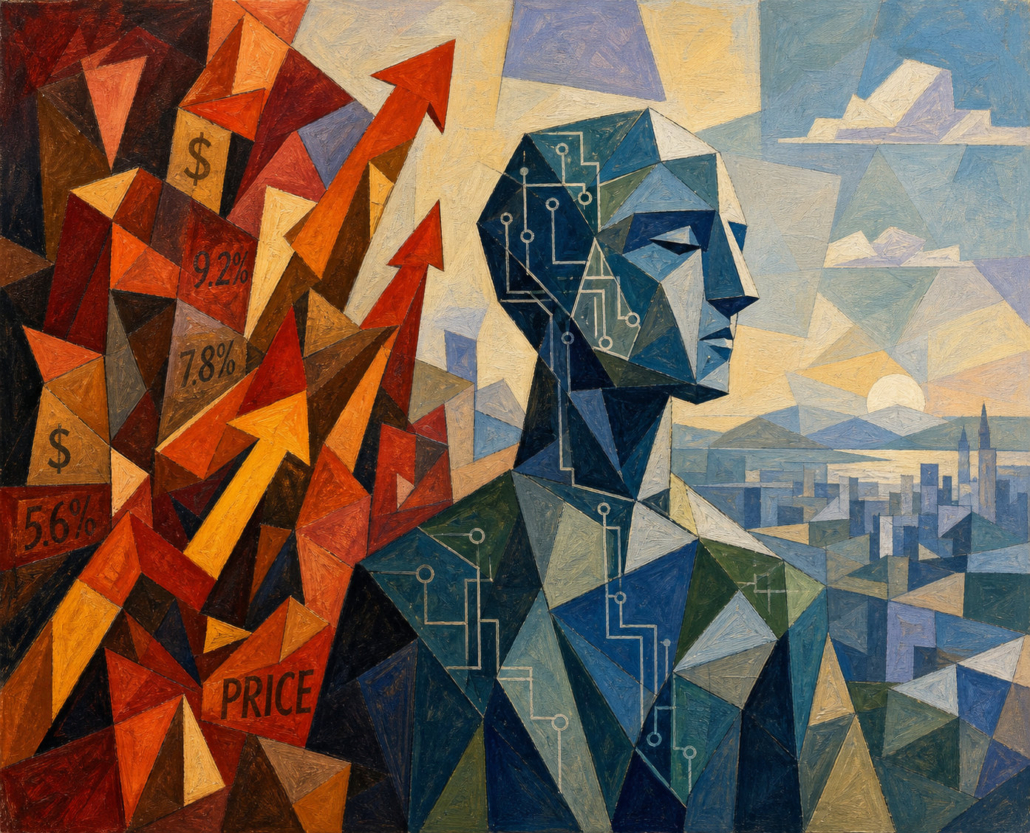
For now, AI is beginning to exert upward pressure on consumer prices in the United States—via the rising cost of electronics, software, and electricity—before the broader productivity growth induced by this technology even begins to contain inflation.
Business Insider, summarizing Goldman Sachs’ analysis, identified three main channels through which AI is currently contributing to rising inflation:
- First, the strong growth in demand for AI infrastructure has led to higher prices for key electronic components (such as digital memory and batteries), which is driving up the cost of computer peripherals and will likely be reflected in smartphone and personal computer prices in the coming months.
- Second, software companies are raising prices as they integrate AI-based features into their products. Goldman Sachs cites concrete examples: the increase in the cost of Microsoft’s M365 subscription, as well as price increases from Adobe, Duolingo, and Intuit—linked to the deployment of AI-based tools.
- Third, the growing electricity consumption by data centers is driving up rates in certain regions of the United States. According to Goldman Sachs’ estimates, this electricity price increase could add 0.1 to 0.2% to the overall Personal Consumption Expenditures index in the coming years.
According to the bank, AI-related inflationary pressure added about 0.3% to the annual core Personal Consumption Expenditures index over the past year, and about 0.1% to the core Consumer Price Index. Goldman Sachs anticipates a similar effect over the following year.
Certainly, one could argue that 0.1% or 0.3% isn’t inflation—that it’s insignificant. And that all this picky calculation after the decimal point interests no one except those who publish it with a doctoral air. But it’s precisely in their conclusion that the most interesting part hides.
Nevertheless, analysts noted that in the long term, AI should become a disinflationary factor as productivity growth spreads through the economy, production costs fall, and efficiency improves.
Two Constellations of Questions
Constellation 1
But tell me. Won’t we once again hit the Jevons Paradox head-on? Paradoxically, “experts” talk about it very rarely.
I had already described it in one of my previous articles, although from a radically different angle: How We Got Dumber: Why the Flood of Knowledge Fails to Make Us Learn
But in the context of this analysis, this eminently human paradox seems well on its way to confirming Jevons’ correctness once again.
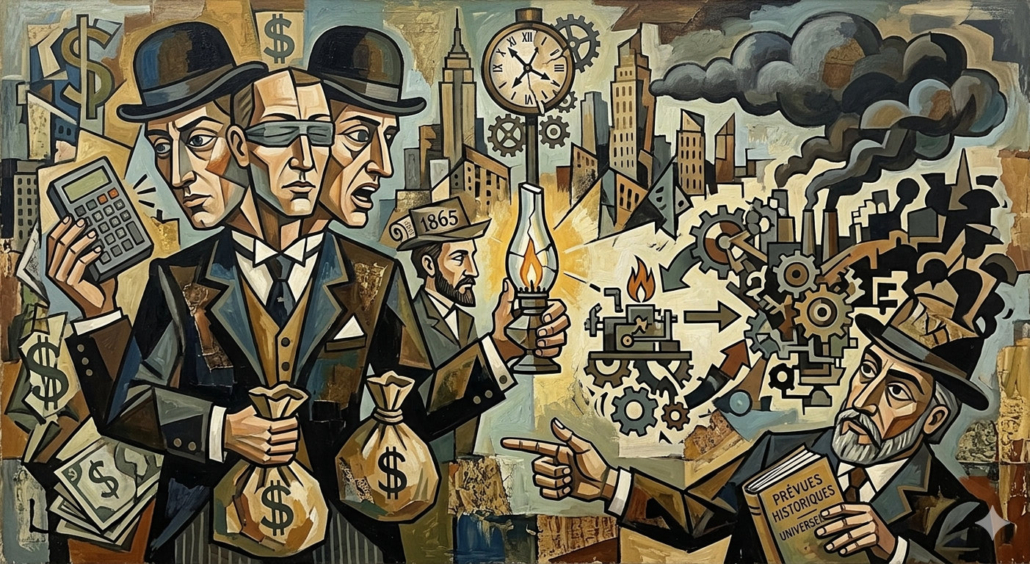
In brief: in 1865, William Stanley Jevons established that
as technological improvements increase the efficiency with which a resource is employed, total consumption of that resource may increase rather than decrease. In particular, this paradox implies that the introduction of more energy-efficient technologies can, in the aggregate, increase total energy consumption.
Even simpler: increased consumption always exceeds efficiency gains. It’s the snake biting its own tail. Here’s some evidence.
- Since humanity began using oil, it has never supplanted coal (the most polluting fossil fuel after peat). Oil was simply added to it, because it serves entirely different uses.
- Gas has not supplanted any existing energy sources either. It was simply added to the others.
- With nuclear—same story.
- Our cars consume less than before, but this generates no energy savings. On the contrary, we keep increasing the automotive fleet. First, everyone wants an increasingly modern and comfortable life. And then, we’re in capitalism: so, we must sell ever more.
Thus, when Goldman Sachs analysts claim that “in the long term, AI should become a disinflationary factor as productivity growth spreads through the economy, production costs fall, and efficiency improves”—no doubt, they know the law of their British economist ancestor, but conveniently ignore it.

Constellation 2
In view of the above, don’t such statements from Goldman Sachs and co. amount to simple neuromarketing? In other words, a lie cleverly disguised as high-level economic advice, whose purpose is to direct the savings of professionals and individuals—read: colossal sums—in a very specific direction desired by a certain minority?
And aren’t there lobbying intentions on the part of this American mastodon, in the context of European attempts to regulate by law the deployment and use of artificial intelligence? Not to mention the international race for capital to finance the creation of a national AI—very costly, moreover.
For the record: since its founding in 1869, this financial corporation has distinguished itself repeatedly in world news—and not always as an angel. For example, Goldman Sachs’ creation of financial derivative products during the subprime crisis and the Greek sovereign debt crisis contributed to the 2007–2011 financial crisis, whose shock the entire planet suffered. And this talented firm is classified as a systemically important financial institution by the Financial Stability Board.
Another question imposes itself: under the cover of financial expertise, isn’t Goldman Sachs trying to feed the whole world lies?
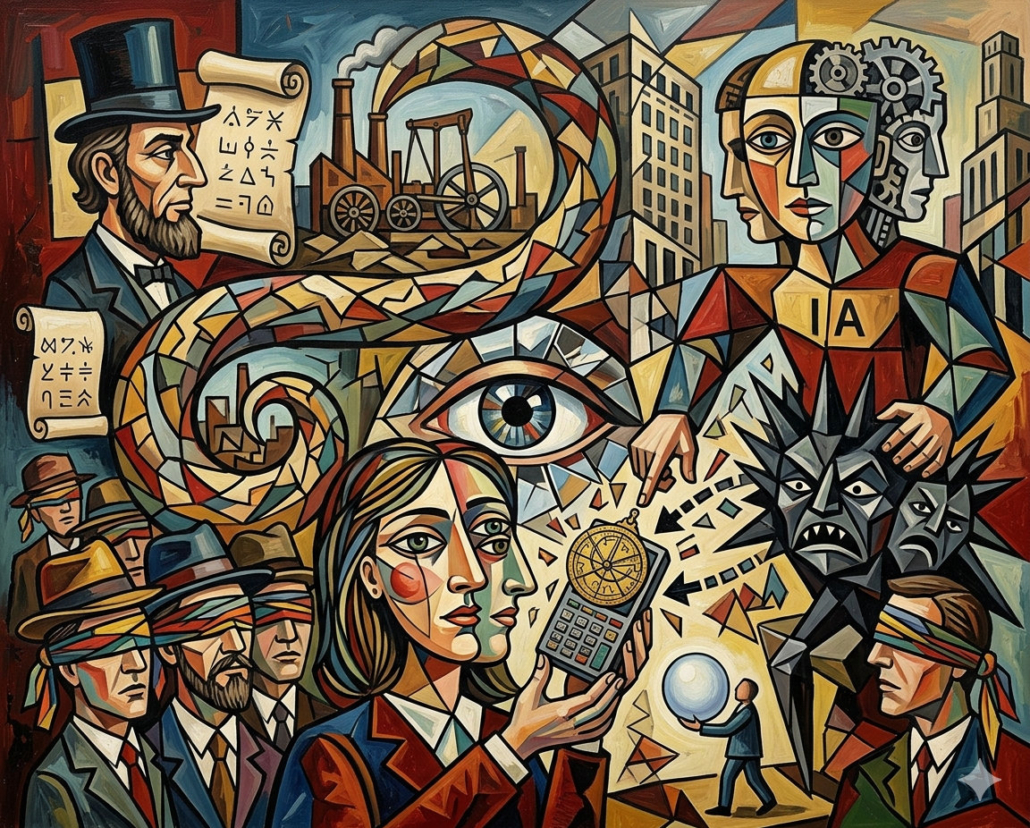
At the time of the Industrial Revolution, their predecessors—capital holders and their bankers—claimed in the same way that the spread of the steam engine in the 19th century would lead to increased efficiency—and therefore to lower costs and resource consumption. Except that history demonstrated exactly the opposite. And to such an extent that, nowadays, no one actually knows how to extract themselves from this vicious circle of our voracious consumption. Because in human nature, consumption growth always exceeds efficiency growth.
Here, one could certainly object that the Jevons Paradox applies primarily to energy consumption. But its deep mechanism is universal: any efficiency gain generates increased demand—and therefore additional costs. Inflation being nothing other than the monetary expression of this inexorable law.
And in the capitalist paradigm, where the concept of profit knows no ceiling, the Jevons effect is merely multiplied tenfold.
In the end, isn’t today’s AI race simply the latest strategy of frenzied and definitively unleashed neocapitalists to attract ever more capital—and with it, power (in every sense of the term)? Only, now on a much more global scale than during the three previous industrial revolutions—steam, electricity, and information technologies.
Marketing
It’s obvious: the AI race is conducted in capitalist interests. And the immense majority of fables spouted by “experts” around AI and the neocapitalism (that gave birth to it) aim to embellish—or even disguise—reality.
Let’s get straight to the point.
What is the main lever—after capital—for the survival and development of any company in a context of fierce competition? Marketing!
Now, my definition of marketing is most laconic: it’s the art of regularly selling what isn’t vital to the buyer—or even what they don’t need. And this is necessary because in capitalism, economic growth (read: profit) is our alpha and omega. Hence the seasonal collections, every year. And why this endless growth? Because, as said above, in the capitalist paradigm, the concept of profit knows no ceiling.
That’s it, that’s all. Going around in circles.
Meredith Whittaker—AI ethics researcher, president of the Signal Foundation, and cofounder of the AI Now Institute—openly attacks tech giants and AI race actors for their rhetoric, which presents AI as an almost divine or prophetic force. According to her, this religious narrative serves above all to concentrate power in the hands of a few dominant corporations—to the detriment of democracy and the public interest. AI is used to strengthen the grip of tech giants (Google, Microsoft, Amazon, etc.) on digital infrastructure and data, generating colossal power asymmetry. She also defines AI as an offshoot of the advertising model: AI is not an inevitable technological evolution, but the direct product of surveillance capitalism and the online advertising business model. Contemporary deep learning models rely on the massive accumulation of personal data collected by large tech companies—making mass surveillance the very foundation of the entire AI industry.
Marketing! The society of euphemisms. Dressing up true intentions in a pink mist on the horizon. Now the horizon, as everyone knows, is an imaginary line that recedes as we advance.
“Currently, prices are rising and will continue to rise in the near future, which is normal due to the inevitable economic transfer of the cost of elements to the final product. But after that—there, on the horizon—everything will stabilize and inflation will stop. Because now we have Artificial Intelligence…”



 © Bluefam