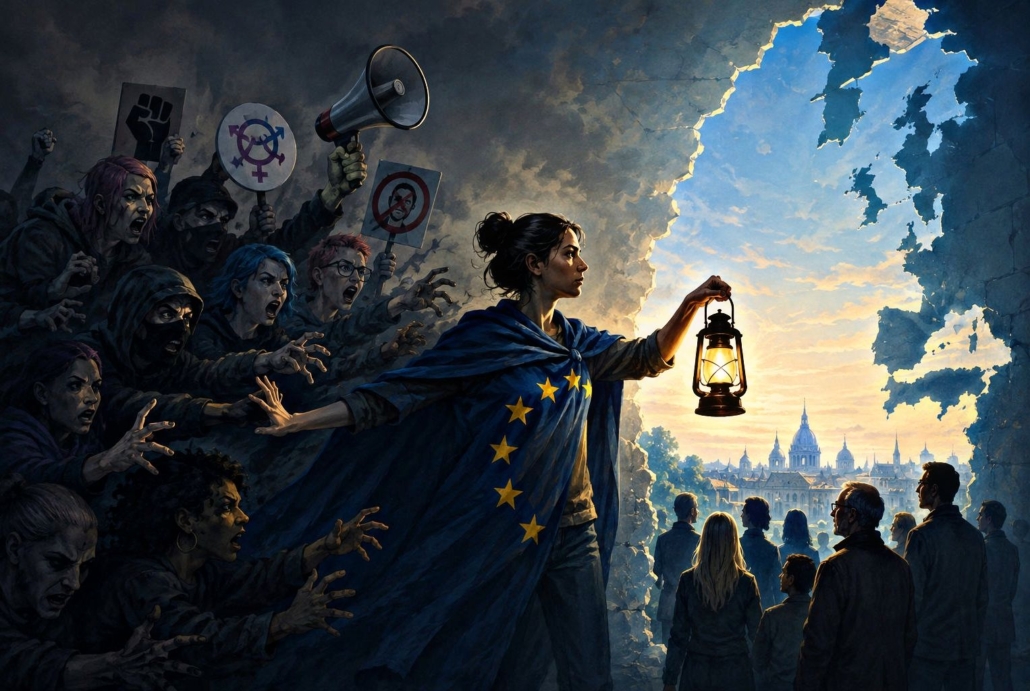
Obscurantism Is Back in Europe — and It Thinks It’s Progressive
Védrine and Godelier
Wokism is increasingly spreading through French universities and research circles…
* wokism — a movement that emerged in the United States in the 1960s and resurfaced forcefully in the 2010s; originally centered on social, racial, and sexual justice, it gradually evolved into a dogma with obscurantist overtones.
MAURICE GODELIER (French anthropologist, Director of Studies at the EHESS, School for Advanced Studies in the Social Sciences, Paris):
One of the internal challenges facing the West is what is referred to as ‘wokism’ and its extreme version, cancel culture. The result is that, in both the United States and Europe, dialogue between many people has become difficult, if not impossible. This ideology is currently invading French academic and research circles.
Wokism is not the consequence of the ‘postmodernism’ of French philosophers such as Derrida and others, who called for the deconstruction of the social sciences. There are two ways to deconstruct a science, whatever it may be, knowing that deconstruction is a stage that all sciences — social or otherwise — inevitably go through: either one deconstructs a science in order to rebuild it with greater rigor and analytical effectiveness, or one deconstructs it in order to dissolve and eliminate it. Wokism has chosen the second path and now constitutes a vital threat that must be confronted head-on.
HUBERT VÉDRINE (French diplomat, Minister of Foreign Affairs 1997–2002):
In Europe, will the fight against wokism — and especially cancel culture — be stimulated by Trump, or on the contrary halted by anti-Trumpism? Are today’s teachers prepared to fight this obscurantism? How were they themselves trained?
We need them. Because cancel culture — the culture of erasure (excommunication, proscription, we know these well!) — is already wreaking havoc in the United States and now in France, in parts of higher education, the media, the arts, cinema, theater, fashion, communications, advertising, and so on. It is censorship returning — eternal censorship — moral order turned upside down. Among the irreplaceable achievements of the post-Enlightenment West are freedom of thought and freedom of speech. We must stand firm on that.
The Secular Inquisition of the 21st Century?
Even if cancel culture is a diffuse social phenomenon without the formal judicial power to torture and execute, as the Inquisition did for five centuries (12th–19th centuries), it nonetheless shares the same psychological and social dynamic: enforced conformity in order to avoid becoming the scapegoat onto whom all accumulated historical crimes are symbolically projected.
Today, it takes the form of a kind of ideological “proper thinking”, conveyed by various movements — largely of American origin — serving diverse interests. It imposes generalized self-censorship: the fear of professional excommunication or even social ostracism, pushing people to silence their opinions and adopt politically correct narratives, sometimes even ending up believing them. The mechanism strongly resembles McCarthyism from 1950–1954 — another American witch hunt. Half a century later, wokism appears to reproduce a contemporary equivalent, this time extending far beyond the Atlantic and producing similarly harmful effects.
These cause-and-effect dynamics have been documented both during the Inquisition and within certain contemporary academic and media circles, not to mention other layers of society.
But let us remain coherent!
We should not idealize the post-Enlightenment West as a historically consistent space of intellectual freedom.
Modern Western history also contains colonialism, political censorship, propaganda, academic orthodoxies, religious and national conformism, and the repression of dissenting opinions — of which wokism is merely one contemporary reconfiguration of older tensions between freedom, social morality, and symbolic power.
It is also important to recognize the limits of this micro-analysis, in which I deliberately oversimplify the causes of wokism without addressing the multitude of parallel structural issues: the economic mechanisms of social media, algorithmic polarization, transformations in education, media fragmentation, the crisis of institutional legitimacy, and so forth.
My aim here is not to write a fully developed analytical essay, but rather to offer — as far as possible — a new point of view.
Why might it be new? Because, through constant collective criticism of external factors — politicians, institutions, corporations, social media, education, the system, or simply “others” (what psychology calls an external locus of control) — we seem to have forgotten the notion of individual responsibility altogether.
Antidote
My threefold response is indirect, but to me it seems perfectly clear.
- “Hideous monsters gnawing at our civilized societies: prejudice, hypocrisy, and other manias of modern civilization.” — Pierre-Jules Stahl, Thoughts and Various Reflections (1841)
- “Bad faith, stupidity, and hypocrisy are the queens of this world.” — Henri-Frédéric Amiel, Intimate Journal (1876)
- “The world will not be destroyed by those who do evil, but by those who watch them without doing anything.” — anonymous
The conclusion is unequivocal: long before us — 200 years ago and even earlier — our predecessors were already raising the very same issues in their societies that we now observe everywhere in ours, supposedly the most developed, enlightened, and democratic society in human history.
The reason is as obvious as it is regrettable: hypocrisy, stupidity, and double standards are inseparable from human nature. In individualistic societies such as Western cultures, they become a kind of vermin that slowly but methodically erodes any social organization — including democracy itself, however imperfect it may be.
So can we simply let the destructive aspects of wokism continue unchecked — a movement that originally pursued the noble fight against real discrimination, certainly, but which has since become exaggerated, intellectually shallow, and distorted?
A perfect illustration of the pharmakon, incidentally — from the Greek: poison and remedy in the same vial, where everything depends on the dosage.
If, amid systemic political incompetence and bad faith, universities and research institutions themselves surrender to hypocritical conformism, then the long-term stability of an already deeply divided West — especially Europe — will become profoundly uncertain.
A civilization that renounces free thinking is sawing off the branch on which it sits. But a civilization that prides itself on being the most democratic of all civilizations is not merely sawing off a branch, but the entire tree. Generalized self-censorship and conformism are, by definition, the antithesis of democracy founded on free thought and free speech.
We should therefore have no illusions: freedom of thought and expression is not a permanent achievement. It must constantly be defended, otherwise it disappears. In other words, those who remain silent today in order to preserve their comfort may well be the first to regret tomorrow what they failed to defend.

If you have read this far, you are probably thinking — perhaps mockingly — that I am merely stating the obvious in a pompous, overly academic tone, indulging in sterile pseudo-sociological grandiloquence perfectly in tune with the spirit of the age. So let me end with one final question.
Might the survival of freedom of thought and expression in Europe ultimately depend on each of us — citizens who possess rights, but also, and above all, duties?
For it is said that “God laughs at men who deplore the effects whose causes they continue to cherish”…



 © Bluefam